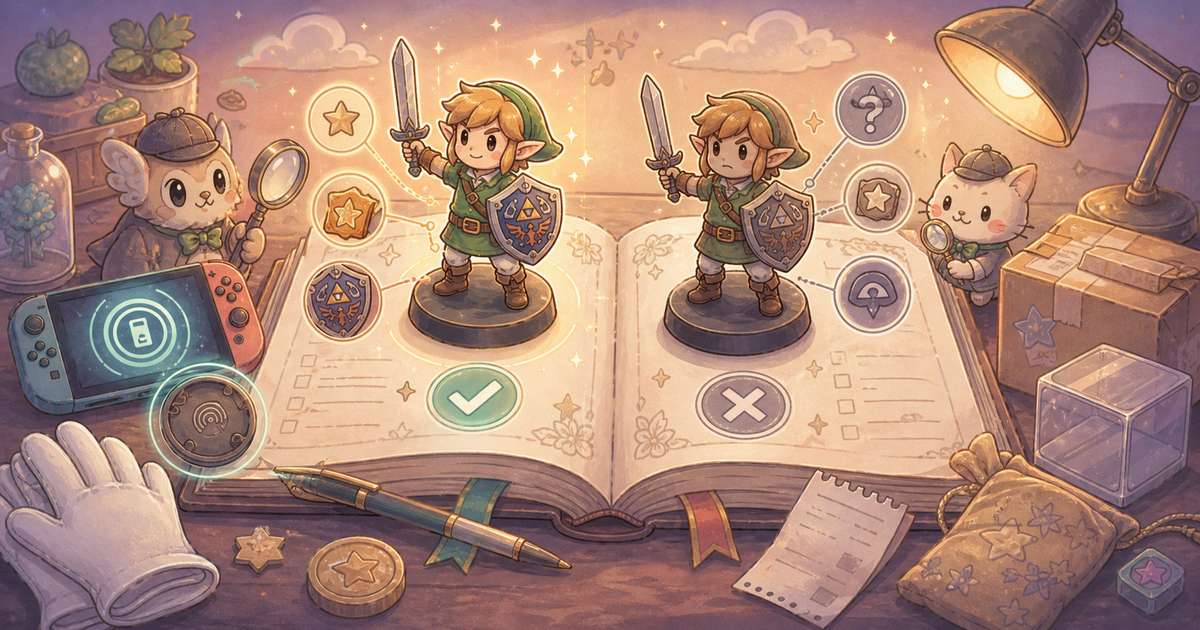
If you buy amiibo on the secondary market, you will eventually encounter a fake. The good ones are good. The bad ones are obvious. Most are somewhere in between — close enough that an honest reseller might not even know — and the only protection is knowing what to look for.
This is the in-hand checklist I run on every used amiibo before I hand over money. None of these signs is conclusive on its own. Two or three together is.
Start with the package (if it's sealed)
- Print quality on the box. Real amiibo packaging is sharp, with crisp typography. Counterfeit boxes often have slightly fuzzy text, off-register printing, or muddy colors. Compare against official Nintendo Store product images or another known-good image online if you can.
- The clear plastic window. Real windows are thick and rigid. Fakes often use thinner, floppier plastic that creases.
- The barcode and product code. The 12-digit code on the back should match the regional Nintendo SKU. Check the SKU against Nintendo's official line-up or release-date records; a wrong-region or invented SKU is a hard red flag.
- The plastic clamshell shape. Authentic amiibo sit in a contoured tray with the figure visible head-on. Off-brand trays often have an extra molding seam down the center.
The base is where fakes give themselves away
The clear plastic base is the single most reliable tell on a loose amiibo.
- The Nintendo logo on the bottom of the base should be sharply printed, in the right font, with the trademark symbol. Fakes often have a slightly wrong font, a missing ®, or a logo that's noticeably faded.
- The series name and figure name on the underside should be cleanly printed, white-on-clear. Counterfeit prints are frequently smudged, miscentered, or in the wrong font weight.
- The "Made in China" line and country-of-sale should be present and legible. Missing legal text is a flag.
Nine times out of ten, the fastest way to spot a fake is to flip it over and read the base. Counterfeiters paint the figure carefully and rush the printing nobody photographs.
Paint and sculpt
- Sharp edges. Authentic amiibo paint is generally clean — eyes are inside the eye outlines, color boundaries don't bleed. Cheap fakes have visible slop.
- Skin tones and reds. The reds Nintendo uses are unusually warm. Counterfeits often go too orange or too pink.
- Mold seam. Authentic figures have a hard-to-see seam. Counterfeits often have a visible vertical line down the figure that catches light.
- The base-to-figure join. Real amiibo sit flush with their base. A fake will often have a small gap or a slightly tilted figure.
The NFC test
If you can scan the figure before buying, do it. Authentic amiibo work the first time, every time, on any compatible NFC reader — Switch right Joy-Con, Switch 2, the 3DS NFC reader, or a Pro Controller.
- Failure to read across multiple devices is a strong sign of either a damaged chip or a fake.
- Reads as the wrong character — sometimes a counterfeit will register, but as a different figure entirely. This happens when sellers clone NFC dumps but mislabel the print.
- Reads but rejects in-game — Smash Ultimate, Splatoon 3, and a few other games run additional verification. A bootleg may scan fine on the system menu but fail to summon a Figure Player.
The scam routes to know
Most fakes in the wild come through three channels:
- "Mystery" or "grab bag" amiibo lots on auction sites, often with low-resolution photos.
- Rare-figure listings well below market — gold Mario, Solid Snake, Shovel Knight, original Villager. If the price is half of what completed sales show, assume fake until proven otherwise.
- Loose figures sold without the base — the base is the easiest tell, so removing it is convenient for sellers who'd rather you not check.
Buy from people, not algorithms
The single best protection isn't a checklist — it's buying from sellers with feedback histories that include other amiibo, on platforms with buyer protection. Resale apps that don't authenticate are buyer-beware no matter what the listing says. eBay, Mercari, and Whatnot all have specific amiibo communities where regulars build reputations. Use them.
If you're new to the secondary market, the rule I'd start with: pay the small premium for sealed-in-box from a seller with two-digit amiibo sales under their belt. By the time you've got enough loose figures on your shelf to spot a fake by feel, you'll know who to buy from and who to skip.
Comments
No comments yet — be the first to say something.